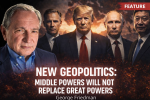
Russia's failure in Ukraine has proven: the Cold War is over, and the world will never be the same. So believes George Friedman—founder of the analytical firm Geopolitical Futures and one of the world's most renowned geopolitical forecasters. In this new podcast episode, he dissects Canadian Prime Minister Mark Carney's speech about an "alliance of middle powers"—and explains why this beautiful idea is doomed to fail. He also discusses why Trump wants Cuba, why the US and Canada can't part ways even if they wanted to, and how serial threats differ from serial conflicts.
Christian Smith: Mark Carney's speech at the World Economic Forum in Davos last month was called by some one of the most important geopolitical addresses of this century. The Prime Minister of Canada declared that the old world order won't return. That we've entered an era of great power rivalry, and middle powers should unite to counter the dominance of hard power.
The question, of course, is what such a collective of middle powers would look like and whether it would work at all? Today on the Geopolitical Futures podcast, we examine the role of middle powers in a changing geopolitical world, as well as the relationship that sparked this entire discussion—the relationship between Canada and the United States.
Additionally, we want to look at America's relations with its southern neighbor—Cuba—and assess whether the regime there can withstand mounting pressure.
My name is Christian Smith, I'm your host, and joining me as always is the founder and chairman of Geopolitical Futures, George Friedman. Hello, George.
George Friedman: Hello. How are you?
Christian Smith: All good, thank you. George, what do you think about the idea of middle powers? Countries like Canada, Australia, Japan, the UK, much of the EU, and perhaps others—some have mentioned India, though it's very large. The idea is that these powers could unite and create their own world order.
The Arithmetic of Middle Powers
George Friedman: Let's start with this. The United States is a quarter of the world economy. China is 20%. That means all other powers account for 55%, just over half. If we count countries with GDP above a trillion dollars, there are about eight. They divide half the world economy among themselves. These are relatively small countries. And if you expand the list, the economies become even smaller.
In other words, the idea that these countries can unite and oppose both the US and China simultaneously, create a new economic system, assumes that middle powers will themselves absorb all this export and ensure each other's economic survival.
Canada, for example, directs about 75% of its exports to the United States and roughly 15% to China. If it loses both markets, it will have to find sufficiently large alternatives. Among countries with GDP above a trillion—about eight. Divide half the world market by these eight countries—none of them individually, nor all together, are a sufficient market for the rest of the world.
First, the numbers simply don't add up. Second, these powers are scattered across the globe. I'd call Germany a middle power. South Korea too. Russia—by this criterion—as well. And here's the question: how will Germany ensure South Korea's security, which sits next to China? A wonderful idea. Irrational, impossible, but sounds beautiful.
Christian Smith: What if we look at it not through the lens of hard power, not from a military perspective? Carney used the term "like-minded"—more of an economic and perhaps values-based unity.
George Friedman: The values of South Korea and Germany fundamentally differ from Canadian ones. In some sense "like-minded," but culturally—completely different. However, it's not about hard power. Economics isn't hard power, but it's absolutely necessary for export countries, and Canada and most others are exactly that. They need markets.
The point is this: the US and China control nearly half the world economy. These countries must find a replacement for China's and America's appetites. A difficult task. Add to this that without security, there's no economy. Nothing is more dangerous than being rich and weak—they'll come for you. Don't sit at a poker table laying out piles of money if you don't know how to play.
Essentially, the idea is that these countries can balance each other, and then balance the great powers—China and the US. From an economic standpoint, this is arithmetically absurd. And simultaneously, however you reason about soft power, military might is a prerequisite. If you have an economy, you must be able to protect it. There are predators in the world.
So these people, gathered together, would make an interesting company, dining together regularly. But whether they can exist beyond the two largest powers, without economic, let alone military relations with them—that's hard to believe.
Scenario of Joint Response to Tariffs
Christian Smith: I look forward to debates about the menu at these dinners—at EU summits the menu is always politically calibrated, so this could be interesting. Let me propose a scenario, George. Much of this discussion arose from Trump's rhetoric on Greenland. What if a number of countries unite in response to tariff threats from the US? Say: "We'll impose tariffs against South Korea," and South Korea responds: "If you do that, Germany, the UK, Canada, and Australia will do the same."
George Friedman: It all depends on the size of their markets. From an economic standpoint—can South Korea compensate for the loss of Chinese and American markets through the German one? The larger the economy, the more it can absorb and export. And these are small, fragmented economies, very far from each other. They're united by only one thing, if this happens: dissatisfaction with the great powers. But dependence on them—economic and strategic—isn't going anywhere.
This is an eternal dream: when there are great powers—and there are always great powers—an illusion appears that you can do without them by uniting. But the numbers don't add up. The market is almost half concentrated in the hands of two countries. If this is economic and financial reality—you have to reckon with it.
Christian Smith: What about the idea that these countries can reduce dependence on the US or distance themselves entirely? I mean Western countries—European ones, South Korea, Japan. Countries heavily dependent on the US, especially militarily, who might now try to reduce risks because they no longer consider America a reliable partner. What's the risk?
George Friedman: The risk is that South Korea ends up next to China without American protection. And that no market will replace the American one in volume. Distancing has two sides. First: "I don't want to depend on US whims." Second: "I want to find an alternative to America." The second negates the first. Finding an alternative to the United States and China together is impossible. China doesn't come close to purchasing what America does.
It all comes down to wanting great powers not to dominate small ones. For small powers to unite—however far apart they are from each other, however much they compete for exports to great power markets, however much they depend on one of the great powers for security.
Germany would certainly like not to depend on the United States. But Germany has both a security question and economic difficulties. It exports cars and plenty of other products to the US. Partially to China, though it has its own industry. And if you add up all these countries, together they don't come close to the economies of the US and China. Because behind them are another thirty to forty countries with small economies.
The calculation is: "We'll get rid of the two great powers economically, but maintain the export markets and financial assets we need. And simultaneously we'll be secure." Germany, for example, will say: "I'm a middle power. I'll ensure my own security." The US will stand and applaud: "Great idea! Be secure without us." And Germany will respond: "But we still want to export our goods to you." To which the States will say: "Fine. But then you depend on us. And we won't buy your goods if you're not our ally."
Great powers are great precisely because they can exert colossal influence—and punish those who break with them. Carney's speech is in the spirit of: "There are seven of us, we're stronger than two schoolyard bullies." But for this you need to be absolutely united and ready for suicide. Usually this doesn't work. A dream, hope, wish. A magnificent speech. And now—reality.
Rupture or Transition?
Christian Smith: Do you think we're experiencing a rupture, as Carney said, or rather a transition? Looking at the history of geopolitics overall.
George Friedman: Look at 1945. All the norms of the previous century collapsed. European empires were falling apart. Europe ceased to be a center of power because it exhausted itself with world wars. Two countries that weren't world powers—the United States and the Soviet Union—came to the forefront.
Europeans could dream of returning to great power status, try to hold onto empires that made them great—but it was impossible. A radically different geopolitical system emerged—the Cold War. You're either pro-American, or pro-Soviet, or neutral. Those are your options, no others.
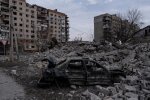
Now look at Ukraine. Russia couldn't occupy it in months, not even in four years—and it became obvious it doesn't pose a threat of invading Europe. That means the Cold War is over. That means a new reality has emerged. The United States no longer needs to remain in the Eastern Hemisphere, waging a covert struggle with the Russians. They can exit this dangerous period.
Americans are now retreating. In two dimensions: military—trying to reduce presence, and economic—asserting their independence from existing systems while continuing to trade actively.
Geopolitical systems are collapsing. In 1945, I think Europeans didn't realize how much they'd lost significance for the world order. They didn't think they'd lose their empires. The old norms were destroyed. Now we're seeing something similar. With the end of the Cold War, after Russia showed its limits, a completely new geopolitical system is emerging, and the old rules no longer work. And those who benefited from the old norms perceive this bitterly as betrayal.
I remember, during the dissolution of the British Empire—if you read testimonies from that time—deep shock reigned in England: how could they find themselves in a position where they had to rely on Americans to hold, say, the Middle East? This is a psychological crisis, unwillingness—especially of leadership raised in the previous era—to face reality. The Cold War geopolitical system has departed after 80 years. A new system is being born.
US and Canada: A Marriage That Can't Be Dissolved
Christian Smith: Let's look at the relationship between the US and Canada. Carney's speech, as you recently wrote, George, grew from a sense of betrayal in Canada. Canada hasn't been at the center of geopolitical attention for the past 80 years, but now that's changing. What's the fundamental nature of the US-Canada relationship?
George Friedman: This relationship is too close and absolutely unbreakable. I perceive it as a marriage. They can't divorce—too much money and everything else. And they can't truly reconcile. But divorce is impossible.
Canada exports a lot, and 75% of that export goes to the United States. It can find other markets, but not for such a volume of goods. Moreover, this production was created for the American market and may not find demand elsewhere.
Simultaneously, the United States critically depends on Canada militarily. Any missile attack would go through the poles. Now military threats come through the Arctic—we saw this with Greenland. Canada is the main buffer between the United States and potential threats. During the Cold War, there was the DEW Line early warning system that tracked Soviet missiles. NORAD (North American Aerospace Defense Command) has always been led by an American, with a Canadian as deputy commander.
If the US loses its relationship with Canada, its position will substantially weaken. Simultaneously, Canada's position becomes extremely vulnerable. If you discard rhetoric and grievances and look at reality—economic ties between the two countries are completely intertwined, and national security is unified. Separating them is impossible.
Canadians, of course, don't like Trump's behavior—like many others. But in reality, their options—for example, turning to South Korea for defense assistance—simply don't exist. In geopolitics, you need to look at two things: real dangers, needs, imperatives—and capabilities. Without the United States, Canada's capabilities would be sharply limited—both in security and economy.
Christian Smith: Interesting about alternatives. This week news emerged—Politico reported that the Franco-German next-generation fighter program FCAS has essentially collapsed. This shows how difficult it is to separate from the US.
And this whole discussion about Canada strongly resembles the Brexit situation in Britain. Whether you like Brexit or not—that's not the point, but what's happening shows how difficult it is to redirect your export markets if you have to do so. Neither side can do it. But it can get worse. How bad can the relationship between the two countries get?
George Friedman: Even if we call each other names across the border and smash dishes, Canada still directs 75% of exports to the States. The States still depend on Canada for security. And whatever animosity we feel, we need each other. We're intertwined. We can't part ways.
There's a difference between what we feel toward each other and how much we need each other. The European Union is full of nations that despise each other. French—Germans, Germans—Poles, Poles—everyone, and the British stand aside with a haughty air. Yet they can't live without each other. Impossible.
Geopolitics doesn't engage in mutual admiration societies. It looks at necessity: where you're located, what power you have, what the other has, economically and militarily, and lives with it.
Will Canada leave NORAD? That won't happen. Will the US expel Canada from NORAD? God, that would be a catastrophe. We need Canada for the economy too. We have nowhere to go from each other. It's like a bad marriage where there's nowhere to move. We'll have to endure it somehow. But for domestic politics, mutual contempt is an excellent tool of national cohesion. Everyone feels great.
Is Canada Preparing to Defend Against the US?
Christian Smith: A couple of weeks ago, information leaked to the Canadian press—obviously an intentional leak from the government—that Canada was preparing a defense strategy against American invasion, some kind of guerrilla warfare plan. Clearly, no one seriously considers this as a real probability. But why release this news? What were they trying to achieve?
George Friedman: Fear-mongering. Politicians want to look strong. Decisive. Defenders of the nation. The more threats they can imagine—threats that won't materialize—the more powerful they sometimes appear. It's very important not to pay attention to politicians' words, because they're politicians, but to look at reality.
Why would the United States invade Canada? We'd only do that if Canadians left our defense system. And by the way, they quite like the position of deputy NORAD commander.
Cuba: Point of No Return
Christian Smith: Since we're here, let's talk about what's happening at the other end of the United States—Cuba. After US special forces captured Nicolas Maduro in Venezuela on January 3, 2026, pressure on Cuba sharply increased. Oil from Venezuela has practically stopped flowing. Right now it's not the most pleasant place. How is Cuba coping—politically, economically, geopolitically?
George Friedman: Its economy is in ruins—and has been in that state for a long time. The Cuban administration, whether communist ideologically or not, has failed. This island could prosper. But it doesn't. By cutting off supplies from Venezuela, the United States partially aimed precisely to cut Cuba off from oil. Now there's a colossal deficit on the island. Russia might be able to supply something. But the situation inside Cuba is catastrophic.
Remember: starting in the 19th century, the United States feared foreign power occupation of Cuba. Back then it was Spain and the fear it could project power onto the US or surrounding waters. That's why John Kennedy, who certainly wasn't Donald Trump, had extremely tense relations with Cuba. The Bay of Pigs invasion (a failed invasion attempt of Cuba by Cuban exiles with CIA support in 1961) is an example.
We'd like to see Cuba in a different position. I think the Cuban people would too. Daily life there is unbearable. There's also internal conflict: the feeling that you're part of this nation and must share its fate competes with the feeling "I can't take it anymore."
I think the United States is trying to provoke an internal uprising against the regime. The regime has a powerful internal security system. Doing such things is dangerous. But the ultimate question is—what will happen to Cuba? The US wants transformation: turning a hostile power into a relatively peaceful one. And in current circumstances, the only possible solution could come from Russia.
But the Russian economy isn't capable of strengthening the Cuban one. And that Russia would take military action for Cuba's sake is extremely unlikely. Cubans are frozen in place. The economy is depleting due to oil shortages, and it was in poor condition before. The standard of living, already low, continues to fall.
I think the US wants to cause an uprising in Cuba. Discontent is enormous. Will it work? The other option is military intervention. The United States has enough power to break Cuba, but it's not easy. Cuba is big. We forget how big it is. It stretches from New York to Chicago. Occupying this territory—even a relatively narrow island—is an extremely difficult military task.
Trump tries to avoid direct military intervention. He prefers to act through intermediaries. Even with Maduro it was a special operation: get in, grab, and get out.
Now the main question is—what will happen inside Cuba? Will regime change occur? And are the United States prepared to spend troops and lives on invasion? At this point, after the Venezuelan events, the strategy is isolating Cuba, intensifying Cubans' suffering, hoping for some mutiny, and perhaps contemplating military action on land. But a blockade seems the most likely scenario. Invasion is improbable.
Christian Smith: Where do you think the critical threshold is for Cuba? The tipping point when something can actually happen? After all, the Cuban regime has always been resilient.
George Friedman: In many ways, we passed that point long ago. The regime was stable, but not because of support—because of effective suppression of discontent. Many Cubans left for the US, succeeded there, maintain ties with relatives on the island. But leaving Cuba has become difficult—authorities rarely allow it. And the US now isn't interested in an influx of Cubans. People are trapped. The threshold of unbearability was crossed many years ago. The regime held on thanks to ruthless internal security forces.
Now something must break. I think Trump's design is to put Cuba in a hopeless position so the regime falls apart, and then use Cuba and develop it—as was done for centuries before Castro.
As for invasion—it's very hard. It will cost us dearly. The Cuban army isn't brilliant, but for defense you don't need much to inflict casualties.
Trump's Serial Threats
Christian Smith: With Trump we're getting used to events replacing each other at tremendous speed: from Ukraine to Russia, from Greenland to operations with illegal migrants and beyond. Perhaps next week we'll be discussing Iran. What do you think is next on his agenda? Negotiations with Iran are ongoing, pressure on Cuba continues. What requires the most attention right now?
George Friedman: Notice: mostly he's talking. With the Russians—no significant military action. In Iran—yes, they bombed nuclear facilities at Fordow, Natanz, and Isfahan as part of Operation Midnight Hammer in summer 2025, but no occupation attempt.
When you say he jumps from place to place—unlike the Cold War, when armies were actually redeployed from region to region, here everything happens at the talk level. He switches from one to another. Take Venezuela: drugs certainly played a role, but the goal was also isolating Cuba from an energy source. It was a military operation—but very small and very effective. He's not going from battle to battle. He's tackling different regions in turn.
When you list—Iran, Ukraine, Cuba, Venezuela—he's not doing that much. In Venezuela—minimum action. Interestingly, he's very cautious about using military force—unless he's sure he'll get by with minimal or zero losses. Meanwhile, he uses American power to isolate countries, to create discomfort. But these aren't serial conflicts, like other presidents'. These are serial threats.
Christian Smith: George, as always, thank you so much for joining the podcast. And thank you, listeners. That's all for today. Next week we'll return with a new episode of the Geopolitical Futures podcast. Until then—take care. Goodbye.