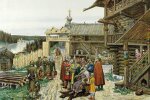
Historian Ilya Chedoluma, in a broadcast with political analyst Yuriy Romanenko, discussed Thomas Barfield’s book "Shadow Empires", describing a unique type of statehood that emerged in Eastern Europe. According to him, Rus and later the Tsardom of Muscovy were for a long time "vacuum empires" that functioned like biological organisms capable of regeneration.
Chedoluma noted that in the 10th century, the forested regions of Eastern Europe were a zone where major players—such as Byzantium, the Holy Roman Empire, and the Khazar Khaganate—lacked direct control. "None of the empires had direct possessions here... there was a power vacuum," the historian explained. Within this space, at the intersection of trade routes, the state of the Rus emerged, initially operating "more like a trading corporation before gradually evolving into a state."
According to Chedoluma, Barfield compares the structure of Rus to a jellyfish, a quality that allowed the state to survive even after losing its capital or territories. "Barfield compares it to a jellyfish... it is a structure that might have a formal center but could survive even if a certain amount of territory disappeared. Roughly speaking, these Rurikid entities, even if their territories shifted, the structure self-restored—much like a jellyfish split in half," the historian said.
He added that this biological resilience allowed the capital to shift easily: "The capital could change several times, moving to different cities. We know that by the time of the Mongol invasion, Kyiv had ceased to be the de facto capital, remaining only a symbolic one."
Ilya Chedoluma emphasized that the Tsardom of Muscovy remained such a "shadow" or "vacuum" empire for a long time. Its transformation into a full-fledged "endogenous" (self-sufficient) empire only occurred at the beginning of the 18th century, following the decline of its rivals—the Polish-Lithuanian Commonwealth, Sweden, and the Crimean Khanate. Ukrainian resources played a decisive role in this process. "Thanks in part to the elites and resources from Cossack Ukraine, the Tsardom of Muscovy... transformed into a full-weight, endogenous empire," the historian concluded.