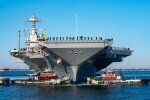
The U.S. Navy has redeployed its newest nuclear-powered aircraft carrier, the USS Gerald R. Ford, to the Mediterranean Sea amid the escalating situation in the Middle East.
According to Hvylya, citing the specialized portal Defence Express, the ship passed through the Strait of Gibraltar on February 20, with photos of its transit already circulating online. Military analysts view this maneuver as a kind of "countdown" to potential American strikes against Iranian territory.
"The minimum time for the aircraft carrier to reach the eastern Mediterranean is estimated at approximately four days," experts note.
From this position, carrier-based aviation, supported by aerial tankers, is capable of striking targets at a range of more than 1,500 kilometers. Guided-missile destroyers within the strike group could also provide a missile defense umbrella for Israel in the event of massive attacks from Iran.
An alternative scenario involves a consolidation of forces: the USS Gerald R. Ford could head to the Arabian Sea to assist another American carrier, the USS Abraham Lincoln. Such a transit would take between 10 and 14 days.
The Ford has been on continuous sea deployments for over eight months, since June 24, 2025. This marks its second dash across the Atlantic to the east during this period. Initially, the carrier was scheduled to return to base for repairs following a mission off the coast of Venezuela. However, a force deficit compelled Washington to extend the ship's deployment timeline.
Currently, the U.S. Navy formally possesses 10 aircraft carriers, but a significant portion of the fleet is undergoing scheduled maintenance or repairs. For instance, the oldest carrier, the USS Nimitz, has already completed its final deployment and is being prepared for decommissioning.
"In effect, the Pentagon can maintain approximately five carriers and four strike groups in a deployed state simultaneously," analysts state.
An additional sign of impending escalation is the active buildup of E-3 AWACS early warning and control aircraft in the region. Experts consider this a clear indicator of preparations for large-scale air operations.