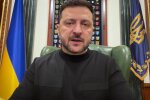
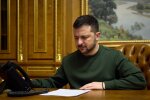
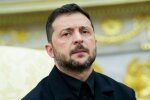
President Volodymyr Zelensky announced that US-Russian economic talks are underway, addressing issues of Ukrainian territory and security. The Ukrainian intelligence service has learned of a package of economic agreements between the United States and Russia, worth as much as 12 trillions dollars. This package already has a name in Kyiv: the "Dmitriev package".
There is nothing accidental about that name. It clearly indicates the political and economic circles from which such an idea originates. It is not a peace package; it is a trade package—one in which Ukraine once again risks becoming a commodity.
Zelensky was clear: Ukraine will not accept any arrangement that violates its constitution, including any recognition of Crimea as Russian territory. That statement should not be news; it ought to be an axiom. Yet, in today's world, this principle no longer seems to hold true.
What makes this alleged package particularly dangerous is not only its financial scale. The logic behind it is dangerous – a logic in which the war does not end with justice but with a "deal". A logic in which aggression is not punished but monetized. A logic in which the territory of a sovereign state is treated as an item on a balance sheet.
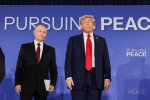
This is the essence of Trump's transactional model of politics. The world is not divided into right and wrong or good and bad but into profitable and unprofitable. Alliances are based not on values but on contracts. Sacrifices are acceptable if they "create space for agreement".
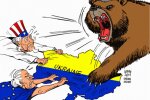
According to this logic, Ukraine is not a country defending itself against aggression; it is "a problem to be solved". And it is solved by turning part of its sovereignty into a ticket for a major deal with Moscow.
The moment "grand deals" are mentioned, Crimea becomes a reference point for whether Ukraine is regarded as a subject or as an object. Recognizing Crimea as Russian would not only violate the Ukrainian Constitution; it would also cancel the entire international order established after 1945.
If Crimea can be "legalized" after its annexation, then no border in Europe can be considered permanent. If aggression is rewarded, it will be repeated. If Ukraine is pressured to accept what was taken from it by force, a message is sent to all revisionist regimes that violence is a rational investment. That is not peace; it is an invitation to the next war.
The role of European countries in this situation is particularly devastating – or, more precisely, their absence. While arrangements that directly affect European security are discussed behind closed doors, Europe remains silent or issues carefully worded statements that do not commit anyone to anything.
For years, support for Ukraine has been presented as a matter of European security. Today, key decisions are discussed without Ukraine’s participation and without European political influence. If Europe allows Trump to negotiate independently with Moscow over Ukraine’s fate, it is accepting its own political irrelevance – and the fact that it will bear the consequences of such agreements.
At this point, the greatest danger is not the specific “Dmitriev package.” The biggest danger is the normalization of the idea that negotiating over Ukraine without its involvement is legitimate, that it is acceptable to treat its territory as a variable, and that it is legitimate to weigh its Constitution against other people’s economic interests. This is cynicism that no longer hides; it is presented as “realism.” But realism that ignores aggression is not realism – it is complicity in a crime.
While amounts and economic packages are discussed, in Ukraine, the dead are counted every day, civilians are buried, and people lose their homes. This is not a difference in perspective but a difference between reality and comfort. Ukraine does not ask for privileges in this situation; it asks for the application of the rules the West has repeated for decades: that borders are not changed by force and that the aggressor is not rewarded with agreements. Any deal that calls this into question, regardless of its economic attractiveness, represents a betrayal of those principles.
In this context, Zelensky’s statement carries significance beyond daily politics. It serves as a reminder that Ukraine, despite enormous pressure, still refuses to accept the logic of trading its own country and future. This is not stubbornness; it is a fundamental responsibility to the people who have borne the burden of a war they did not choose for more than three years. Ukraine cannot support agreements that violate its constitution, as that would mean abandoning the cause for which it is fighting.
At a time when economic arrangements with Russia are being considered in Washington, Ukrainian cities face daily attacks, people are freezing without heat, and Ukraine’s territory is discussed as part of someone else’s negotiation offer. This means the war is not being viewed in terms of who attacked and who is defending. It is a deliberate choice to turn war into a marketplace and sovereignty into an object of exchange. This signals to Moscow that aggression does not close the door to negotiations but accelerates them. Instead of aggression resulting in political isolation, it becomes a way to return to the negotiating table. This alters the dynamics of the entire conflict: weapons no longer serve as obstacles but become arguments. In such circumstances, every Russian grenade gains additional political value. This is the reversal Russia has sought for years – not the admission of defeat, but the normalization of violence.
If Ukraine is negotiated over today as the subject of an agreement between Moscow and Washington, then tomorrow no one in Europe will have the right to invoke security guarantees. Russia will conclude that war pays off if it is fought long enough and brutally enough.