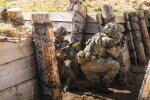
Russia and Ukraine have demonstrated the future of warfare to the world, yet America and its allies remain unprepared for it. This sobering conclusion was drawn following the large-scale NATO exercise "Hedgehog 2025" held in Estonia.
As reported by Hvylya, citing The Wall Street Journal.
The maneuvers, involving over 16,000 troops from 12 NATO nations alongside Ukrainian frontline drone operators, exposed critical vulnerabilities within the Alliance regarding high-intensity drone warfare.
The scenario envisioned a "saturated" battlefield where tanks and infantry would still retain some freedom of maneuver. However, in practice, plans unraveled. A combat group consisting of a British brigade and an Estonian division attempted an offensive but failed to account for the absolute transparency of the battlefield caused by drone surveillance.
"They were just walking around, not using any camouflage, parking tents and armor in the open. It was all destroyed," recalled one participant who played the role of the enemy.
Opposing the NATO forces was a small team of approximately 10 Ukrainians utilizing the Delta situational awareness system. This platform aggregates intelligence in real-time and coordinates strikes within minutes. The result was stunning: in just half a day, the Ukrainian group simulated the destruction of 17 armored vehicles and carried out 30 strikes on other targets.
Aivar Hanniotti, coordinator of drone systems for the Estonian Defense League (Kaitseliit), who led the opposing unit, described the results for NATO as "terrible." His group of about 100 people, including the Ukrainians, managed to "wipe out two battalions in a day."
"In terms of the exercise, they effectively lost combat capability. The NATO side couldn't even get close to our drone crews," Hanniotti emphasized. He added that although the drone density was half that of the actual front line in Ukraine, concealment was impossible: "We found vehicles and mechanized units quite easily and quickly knocked them out with strike drones."
Maria Lemberg, a representative of the Ukrainian organization Aerorozvidka who helped coordinate Ukraine's participation, noted that too many NATO members continue to demonstrate a "fundamental misunderstanding of the modern battlefield" and are training soldiers based on obsolete doctrines.
The publication cites the telling reaction of one Alliance commander who, observing the rout of his forces, summarized the situation succinctly: "We are f—."
Lieutenant Colonel Arbo Probal, head of the Unmanned Systems Program for the Estonian Defense Forces, commented on this reaction pragmatically: "From my perspective, mission accomplished." The objective of the exercises was precisely to create shock and cognitive overload, forcing troops to face reality and shed their complacency.