Following the conclusion of the war in Ukraine, regardless of its outcome, Russia will face the threat of a massive internal explosion caused by the return of millions of armed men. To avoid a civil war, the Kremlin will be forced to "channel" this aggression outward, with the Baltic states becoming the only accessible target.
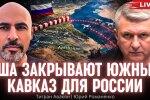
Analyst Tigran Avakian delivered this forecast during a broadcast with Hvylya editor-in-chief Yuriy Romanenko.
According to the expert, Moscow’s primary post-war challenge is the demobilized "horde."
"Russia is left with a massive population of armed individuals—hundreds of thousands, perhaps a million people who have gone through war, whose psyches are shattered, and who are accustomed to killing and looting. What do you do with them? If they return home, it’s a social explosion. It’s 'Gangster Petersburg' multiplied by a hundred. It’s a civil war. Putin needs to channel them somewhere," Avakian emphasized.
Analyzing potential directions for new aggression, the expert pointed toward NATO countries. He argued that the path to the South (the Caucasus) is blocked by an alliance of Turkey, Azerbaijan, and Armenia under a "U.S. umbrella," while China will not permit a move to the East (Central Asia).
"Xi Jinping has made it clear: 'This is my zone.' As soon as [propagandist] Solovyov starts shouting about a march on Kazakhstan, he is immediately silenced. China will not allow the 'Silk Road' to be destabilized," he explained.
Consequently, Avakian argues that Putin has only one vector remaining: "Only one direction is left. It is geographically accessible, logistically straightforward, and ideologically 'appetizing' for the Russian public. That is the Baltics. The Suwalki Gap. Narva. The 'protection of Russian speakers.' There are no mountains, no difficult terrain, just a direct border. Most importantly, it is NATO—the 'main enemy' itself."
Commenting on the doubts of Western analysts (such as George Friedman) regarding Russia's inability to launch a new war due to exhaustion, Avakian noted that the Kremlin operates under a different logic.
"Friedman thinks in categories of 'victory' and 'efficiency.' I am talking about the categories of 'regime survival' and 'disposal.' They don’t need a three-day victory over NATO. They need a process. They need to ensure this horde doesn't return to Ryazan and Voronezh. They need to send them to die somewhere else."
The expert also expressed skepticism regarding the Alliance’s automatic protection. He envisions a hybrid scenario where Russian tanks could reach Tallinn faster than Brussels reaches a decision.
"Are you certain Article 5 will work the way it's written on paper? Look at what’s happening in Europe. Germany is in crisis; France is in political chaos. The Kremlin’s calculation might be simple: a hybrid strike. 'We aren't there,' 'those are local insurgents in Narva,' 'protecting rights.' While Brussels holds meetings and expresses concern, Russian tanks are already in Tallinn. What does Scholz do then? Declare war on a nuclear power? Or say, 'Well, let’s negotiate a new line of demarcation'? This is a test for NATO. Putin may want to conduct this test to show the world that NATO is a paper tiger," Avakian noted.
In this situation, Ukraine's role changes fundamentally. Europe, recognizing its own weakness, will be forced to turn to Kyiv for help: "In this configuration, Ukraine becomes more than just a 'buffer'; it becomes the only real force with experience fighting this horde. The paradox is that Europe may eventually have to ask the Ukrainian army to defend NATO’s eastern flank."
He does not rule out the possibility of Ukrainian troops being stationed in Lithuania or Poland as part of a new security architecture: "Moreover, this could be part of our security guarantees. 'We give you weapons and money, and you provide us with security.' Because the Germans have no army, and the French have a small expeditionary one. The only combat-capable army in Europe in two years will be the Ukrainian army—and the Polish one, which is currently being built."