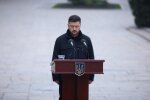
Ukrainian President Volodymyr Zelenskyy told reporters on December 9 that he is ready to hold elections under martial law and shared details of ongoing negotiations with the American side.
"I am ready for elections. I will be in Ukraine tomorrow and expect proposals from partners, as well as from our MPs regarding legislative changes to hold elections during martial law," Zelenskyy stated. The President also appealed to the US and European partners to ensure security for the electoral process, noting that under such conditions, Ukraine would be ready for elections within 60 to 90 days.
Regarding the peace process, Zelenskyy revealed the existence of three documents: a 20-point framework document that is constantly evolving, a document on security guarantees, and a document on post-war reconstruction. According to him, the initial US plan contained 28 points, but following a presentation by Defense Minister Rustem Umerov, provisions controversial for Ukraine were removed.
"I think we will hand over the updated peace plan to the US tomorrow," the President said, adding that work is being conducted at the advisor level.
Zelenskyy confirmed that the US is currently not ready to see Ukraine in NATO. "These aren't games; it seems to me this is open information. But it is undoubtedly a question for the future," he noted. At the same time, the President emphasized the importance of bilateral security guarantees between Ukraine and the US, pointing out that the 20-point document refers to a mechanism analogous to NATO Article 5.
Addressing potential talks with Russia, Zelenskyy stated there are none: "We have no negotiations with the Russian Federation; they show no interest." The President highlighted continued Russian strikes on energy infrastructure as evidence of Moscow's lack of interest in the peace process. However, Zelenskyy confirmed Ukraine's readiness for an energy truce should the Russian side demonstrate reciprocal willingness.
The President also commented on Ukraine's missile program, confirming the use of "Long Neptunes," "Palyanitsia," "Flamingo," and the start of "Sapsan" usage. "Neptunes work very well indeed, and there are moments when our enemy believes there was a Neptune strike, so let them continue to think so," Zelenskyy said, refraining from disclosing details.
When asked about a possible meeting with Donald Trump this week, the President replied: "We will be in contact with the US. We are ready for any date." He also announced upcoming meetings with European colleagues and US officials at various levels.
The negotiation process to end the war in Ukraine has been ongoing for several weeks. The initial 28-point plan presented to Ukraine by the Trump administration on November 19 envisioned holding elections 100 days after signing, constitutional amendments renouncing NATO accession, and capping the Armed Forces of Ukraine at 600,000 personnel. In return, Ukraine was to receive "reliable security guarantees" from the US. The document has undergone significant changes during negotiations — the updated version contains strengthened security guarantees, and Kyiv is not being asked to cede territories currently under Ukrainian control.
The issue of security guarantees remains key for Kyiv. According to Politico, Trump agreed to provide Ukraine with security guarantees outside NATO, though without specifying their content. The European Union has prepared an alternative 24-point plan which envisions legally binding security guarantees analogous to NATO Article 5 without restrictions on the size of the Armed Forces or the defense industry.
In parallel, Ukraine continues to advance its own missile program. According to The Economist, the country is developing six new types of missiles, including the long-range Neptune cruise missile and the Hrim-2 tactical ballistic missile (also known as Sapsan), developed at the Yuzhmash plant. The private sector has also joined production efforts — the "Palyanitsia" drone missile is already being used to strike enemy military depots.